SHOP CURATION: COLLECTIONS
By Paige Rindone, AF Contributor, Poet · August 31, 2026If you’ve looked at a restaurant menu when hungry, you know how much it helps to easily find the section that immediately makes your mouth water. (I don’t play around, I am for sure skipping right to the dessert section.) But imagine the chaos of an experience where the menu isn’t organized in at least some type of way. (Hangry is not a pretty picture.)
While it might not be that dramatic with patrons browsing your storefront, why take the chance? Or better yet, why not enhance their experience in your shop?
What are “Collections”?
Your shop homepage will automatically come with two menu links: “Home” and “All Products.” Collections are groupings of your inventory, accessible via the menu links (navigation buttons) that sit at the top of your online storefront.
This guide offers insight into how to name and organize your shop’s collections with both tried-and-true examples as well as more outside-the-box inspiration. Only one item is required to create a collection, so even if you manage a small number of items, your patrons can learn a lot about your shop by the menu links alone.
It’s okay to get creative and it’s okay to keep it simple
Your shop is uniquely yours. Your collections can be too. However, they don’t have to be where your cleverness shines brightest because there is nothing wrong with simple.
Take, for example, Linda Lobster’s shop, “Not Sally’s Seashells,” where she sells her upcycled seashell jewelry. (Note: this is a fake shop for demonstrative purposes.) From found seashell fragments, Linda creates primarily necklaces and earrings.
Collections by Attribute
Linda opts to organize her jewelry based on their subcategory. The visual below shows her two customized collections: “Seashell Earrings” and “Seashell Necklaces.”
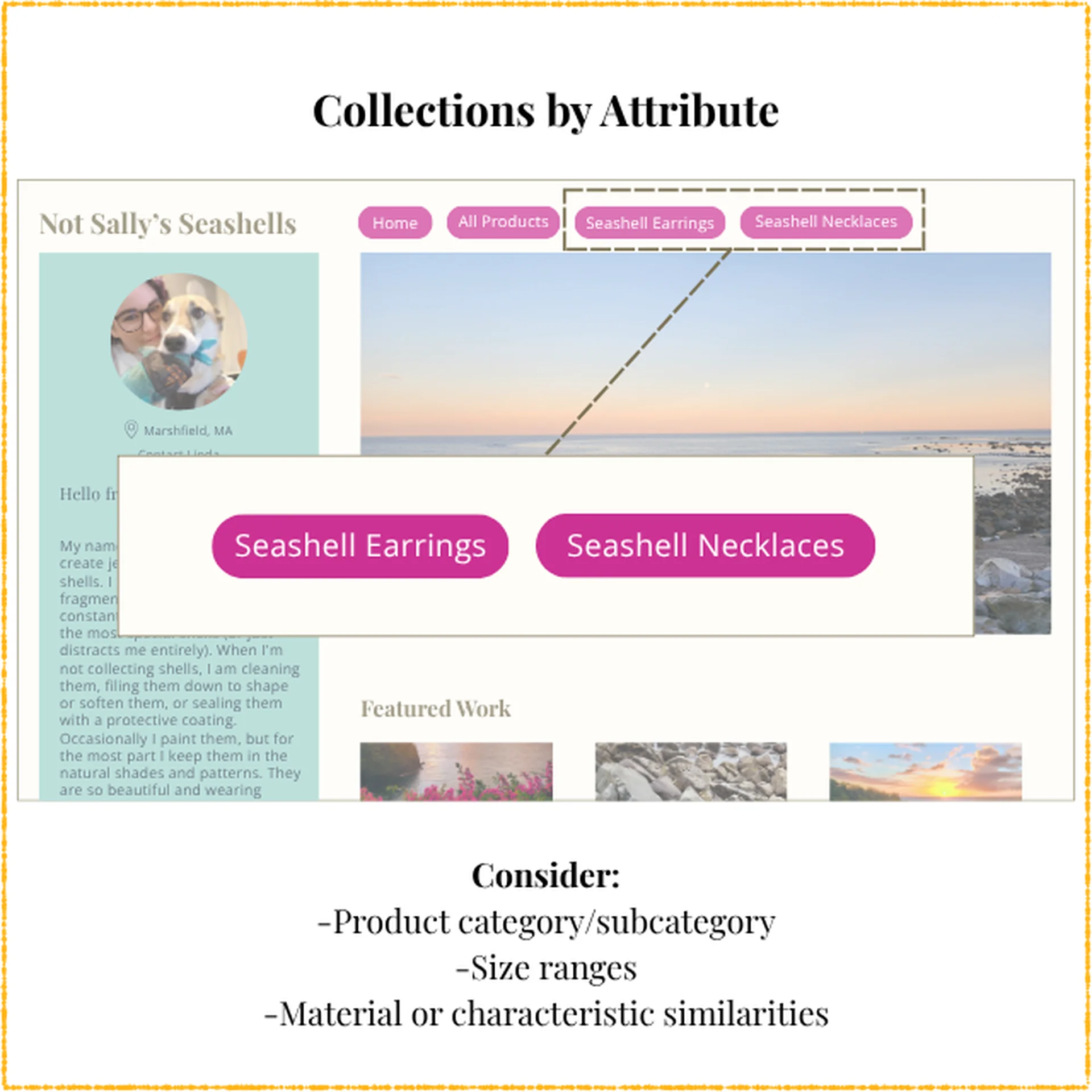
Attributes can include categories, subcategories, sizes, materials, and more. Consider if you are a quilter, you could opt to organize by size (i.e., Queen Quilts, Full-Size). If you’re a visual artist working with different materials, you could set up your collections to reflect your variety (i.e., Acrylic Paintings, Mixed Media Canvases). Grouping by attribute is simple, straightforward, and an organizational method that’s applicable to just about any artist and medium.
Collections by Inventory
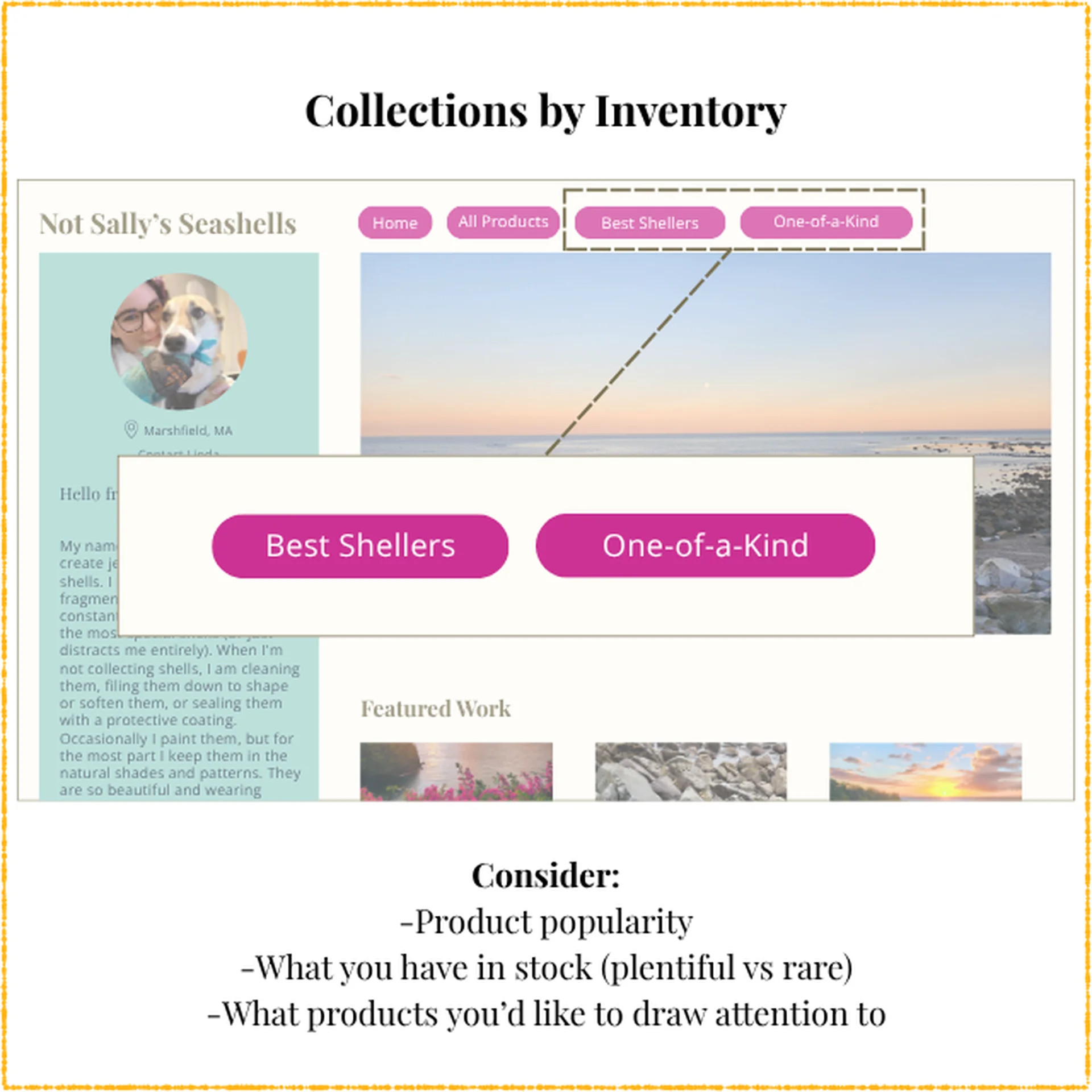
Another simple option for grouping is by inventory or popularity. Do you make or have a lot of a particular kind of creation? Reflect on what sells the most or gets the most attention. Or point patrons to where you want their attention.
The image below shows Linda’s way of grouping her jewelry that entices patrons to explore both her most and least popular items. She introduces punny humor by naming one of her Collections “Best Shellers” while drawing attention to her more unique items (and unique patrons) with her second Collection, “One-of-a-Kind.”
Collections by Theme
Another way to consider setting up your collections is thematically. You might create a series of work that feels thematically cohesive. Let’s say Linda Lobster usually creates jewelry from seashells found in her hometown, by the Massachusetts seaside. But after a recent visit to a California beach, she created a whole new collection of jewelry from the pieces found there.
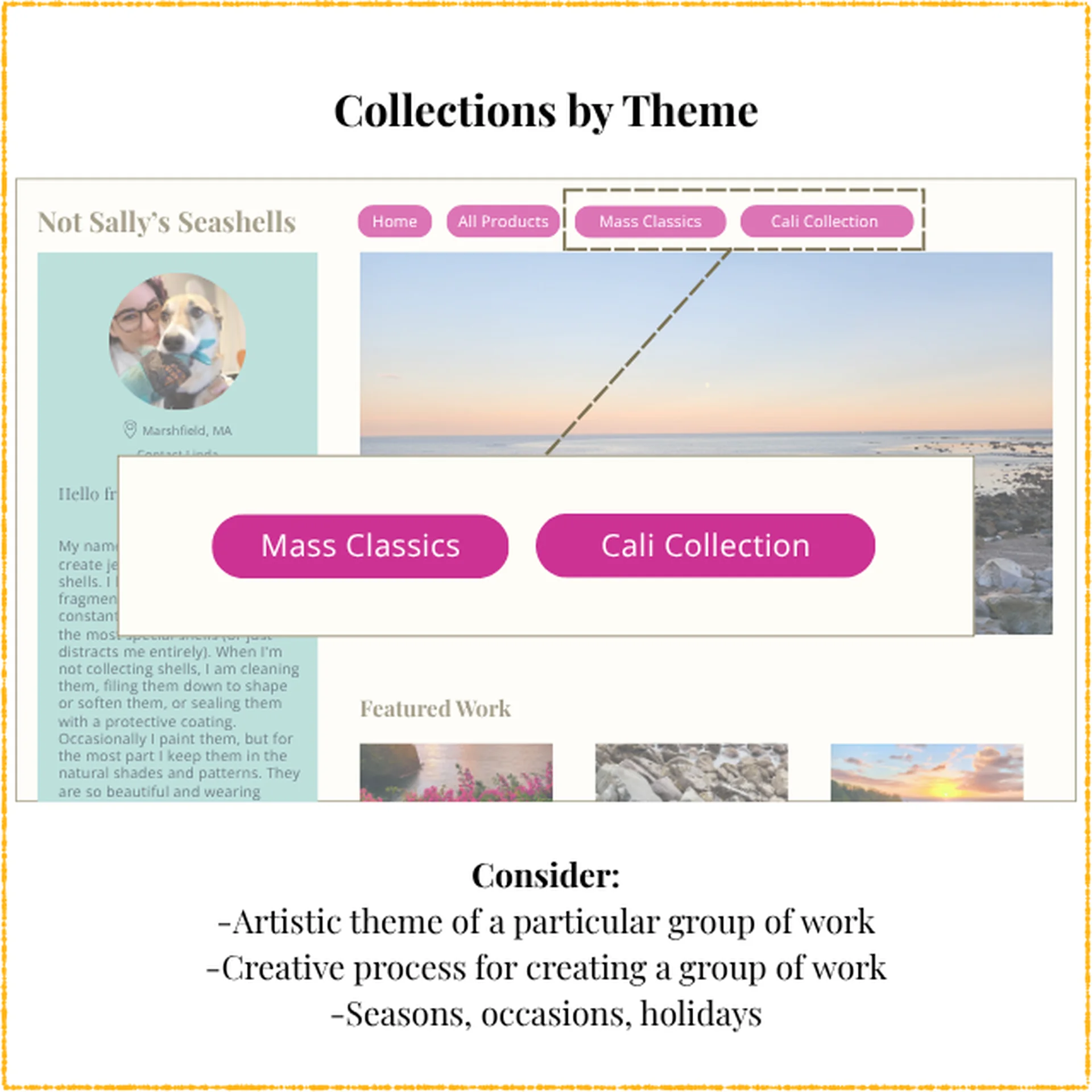
Collections can be inspired by the artistic themes of the pieces, by the way in which groups of artwork are created, or by thematic events such as holidays or seasons. If you’re a ceramicist making hand-painted mugs and you’ve just created a batch inspired by all things Halloween, maybe you add a collection named “Spooky Sips” or “Coffee Cauldrons.” Alternatively, you could go classic with “Halloween Mugs” or “Harvest Specials.”
Collections by Patron Motivation
You could also organize your collections by considering how (or why or for whom) your patrons shop. What is driving them to browse your storefront and purchase your art? For Linda Lobster’s shop, she updated her collections to reflect the primary reasons her jewelry is purchased: “Self-Love Seashells” and “For Your Beachy BFF.” By organizing her handcrafted jewelry this way, patrons are given two reasons to buy: for themselves and for their best friend.
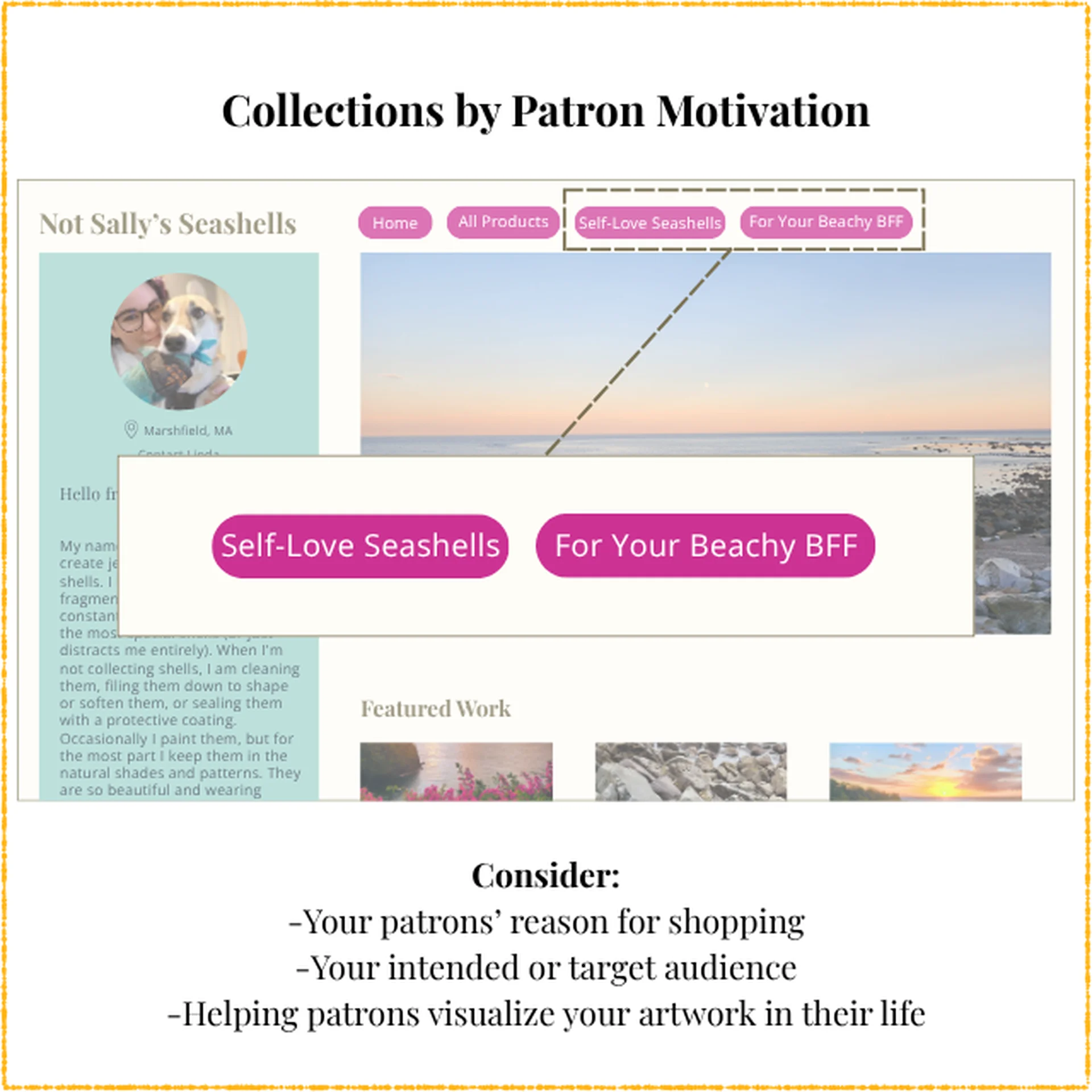
These collections could also address patron motivation in a less direct way, by filling in the blank of this statement: “if you like this kind of thing, then you’ll love my creations.” Maybe an artist cross-stitches a variety of woodland-themed pieces, prompting two collections named: “Friendly Fauna” and “Mushroom Mayhem.” When there is personality in the name, you tap into the personality of the patron.
Do not let perfectionism stop you
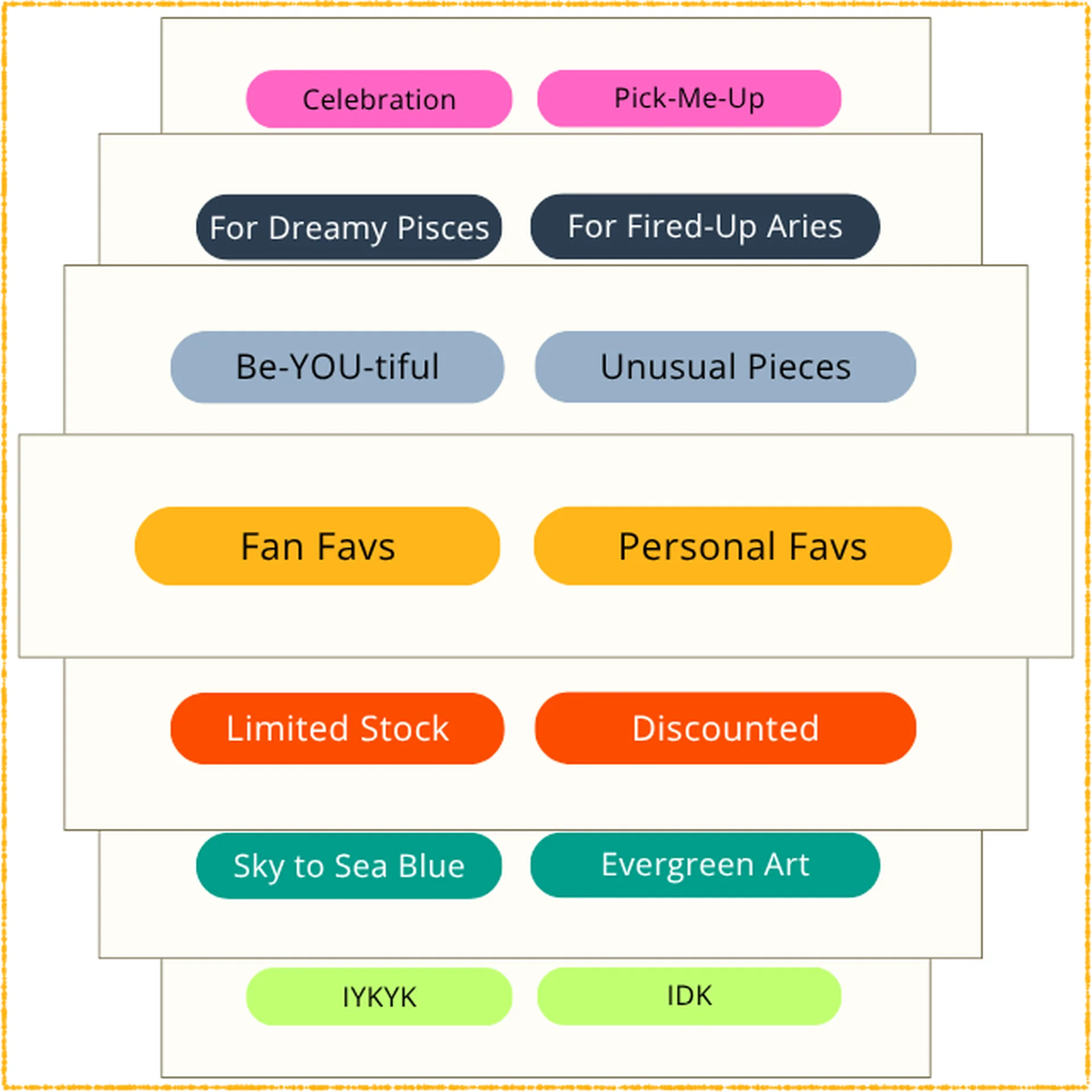
There are plenty of other ways you could organize your collections. Think color-schemes, mood or emotion, astrological or personality traits, or something else entirely. Consider ways to group your products that mean something to you.
Whatever idea you have, go for it. Even if it seems boring or simple. Even if it seems too wacky or “out-there.” You already put so much work into creating your creations, and you’re likely deeply familiar with battling perfectionism. Your shop does not need to be perfect. There is no such thing. It is going to be great because you are great. And your collections and menu links (like most aspects of your customizable shop) are changeable.
Remember that if a patron is in your shop, you’ve got their curiosity piqued. And most of the time, patrons are coming hungry. The question is, how do you wish to steer them to your mouth-watering dessert section?